
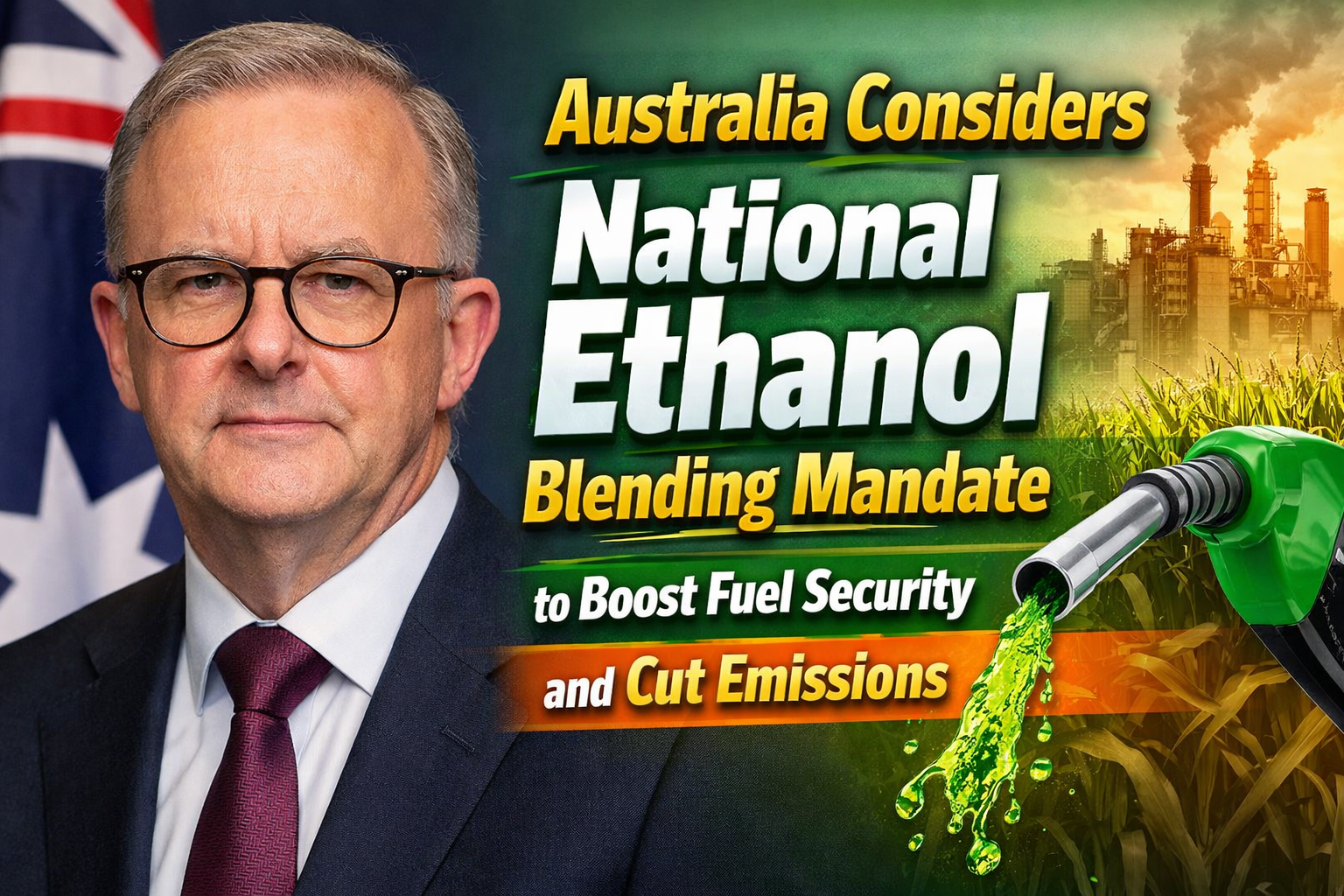
Australia stands at a crossroads in its energy policy, with growing calls for a national ethanol blending mandate to safeguard against volatile global oil supplies and accelerate the shift to cleaner fuels. Sparked by recent Middle East tensions that threaten fuel imports, industry leaders and policymakers are championing ethanol—derived from abundant sugarcane— as a homegrown solution offering both security and environmental gains. This potential policy shift could transform fuel stations nationwide, blending biofuel into everyday petrol to reduce emissions while bolstering domestic production.
Roots of the Push: Fuel Security in Peril
Recent conflicts in the Middle East have exposed Australia’s heavy reliance on imported oil, with the Strait of Hormuz—a chokepoint for global crude—under threat of disruption. The nation holds less than a month’s supply of key fuels like petrol and diesel, leaving motorists and industries vulnerable to price spikes and shortages. Proponents argue that ethanol, producible from local sugarcane waste, provides a buffer against such shocks, allowing blending into existing petrol infrastructure without massive overhauls.
Sugar mills in Queensland, already exporting ethanol to markets like the Philippines, sit idle on untapped potential due to patchy state-level rules. A national mandate would redirect this resource inward, creating jobs in regional areas and stabilizing pump prices. Critics of imports highlight how war-driven surges could add cents per liter, hitting families and freight hardest.
This urgency mirrors global trends, where nations blend biofuels to hedge geopolitical risks, positioning Australia to follow suit with its agricultural strengths.
Current Landscape: Patchwork State Policies
Ethanol blending operates unevenly across Australia, confined to Queensland and New South Wales without federal backing. Queensland requires four percent of regular unleaded sales to include ethanol, targeting large retailers, while New South Wales pushes for six percent but grants frequent exemptions when prices climb. Other states like Victoria and Western Australia have no such rules, resulting in national averages hovering between one and two percent—far below the ten percent common globally in E10 fuels.
Exemptions plague even these schemes: retailers dodge mandates citing infrastructure costs, supply shortages, or ethanol exceeding “reasonable” wholesale benchmarks tied to U.S. and Brazilian imports. Consequently, domestic production lags, with ethanol often cheaper to export than blend locally due to its lower energy density compared to pure petrol.
| State | Blending Mandate | Typical Compliance | Key Exemptions |
|---|---|---|---|
| Queensland | Four percent on regular unleaded | Rarely met fully | Supply issues, upgrade costs |
| New South Wales | Six percent average | Below target | Price thresholds, infrastructure |
| Victoria | None | Voluntary low blends | N/A |
| Western Australia | None | Minimal uptake | N/A |
| Others | None | Negligible | N/A |
This fragmented approach undermines scalability, leaving biofuel producers as price-takers in a fossil-dominated market.
Benefits of a National Mandate: Dual Wins for Security and Planet
A federal ethanol mandate, modeled on refined state versions, promises multifaceted gains. Fuel security tops the list: blending ten percent ethanol into petrol—fully compatible with most vehicles—could displace millions of liters of imported fuel annually, leveraging Queensland’s sugarcane for self-reliance. During crises, E10 delivers octane boosts akin to premium RON95, maintaining performance while cutting exposure to overseas turmoil.
Environmentally, ethanol slashes tailpipe emissions by fifteen to twenty percent versus straight petrol, offering the cheapest abatement option through the decade. Lifecycle analyses show sugarcane ethanol—grown renewably—beats fossil fuels on carbon, especially when paired with co-products like bagasse power. For aviation, it feeds sustainable fuels, aligning with net-zero goals.
Economically, mandates spur investment: new distilleries, jobs in milling heartlands, and reduced excise burdens since E10 qualifies as standard petrol. Motorists benefit from stabilized prices, as domestic supply curbs import volatility.
| Projected National Impacts |
|---|
| Fuel displaced: Millions of liters yearly from imports |
| Emissions cut: Fifteen to twenty percent per blended liter |
| Jobs created: Hundreds in regional processing |
| Price stability: Buffered against global shocks |
| Aviation synergy: Feedstock for sustainable jet fuel |
These upsides position ethanol as a bridge fuel, buying time for electrification.
Industry Voices: Sugar Sector Leads the Charge
The Australian Sugar Manufacturers association drives the campaign, urging Canberra to enforce blends via an improved Queensland template—minus loopholes. Chief executive Ash Salardini emphasizes ethanol’s role beyond cars: as precursor for renewable diesel and jet fuel, countering aviation’s tough decarbonization. Amid Iran-related oil fears, they frame mandates as urgent national strategy, projecting modest E10 rollout as affordable resilience.
Sugarcane growers echo this, noting exports drain potential while local pumps run dry on blends. Queensland’s bioenergy inquiry, reporting soon, bolsters their case with data on untapped mill capacity. Allied voices from biofuels digests highlight Australia’s lag versus global leaders, pushing for harmonized rules to hit SAF targets.
Opposition remains muted, focused on logistics rather than outright rejection, signaling ripe ground for consensus.
Technical Feasibility: Blending Without Barriers
Modern vehicles handle E10 seamlessly, with labels at pumps ensuring awareness. Australia’s excise treats such blends as full petrol, avoiding penalties and easing retailer transition. Infrastructure needs minimal tweaks—seals, tanks, pumps—already standard in mandated states, scalable nationwide via incentives.
Challenges like ethanol’s lower energy (requiring slight volume increases) fade against savings from scale. Quality controls match global norms, with food-grade variants serving sanitizers or chemicals profitably. Pilots prove E15 viable for flex-fuel fleets, hinting at future-proofing.
| Vehicle Compatibility |
|---|
| Standard petrol cars: Fully E10-ready |
| Flex-fuel: Up to E85 capable |
| Infrastructure upgrades: Low-cost for most sites |
| Excise treatment: E10 as standard petrol |
| Global precedent: Widespread E10 success |
Rollout could phase in over years, starting voluntary then mandatory, minimizing disruption.
Economic Modeling: Costs Versus Gains
Mandates yield net positives, per industry math. Initial blending costs—ethanol at parity or below petrol—drop with volume, subsidized by security premiums. A ten percent mandate might lift pump prices by fractions initially, offset by averted import crises costing billions in past spikes.
Sugar regions boom: expanded crushing seasons, by-product power sales, export diversification. Nationally, reduced oil imports free forex for renewables. Sensitivity analyses show robustness even if sugarcane yields dip, thanks to waste feedstocks.
| Cost-Benefit Snapshot |
|---|
| Upfront: Minor infrastructure, cents per liter |
| Ongoing savings: Import avoidance, emissions credits |
| Regional GDP lift: Billions from agribusiness |
| Consumer: Stable pricing long-term |
| ROI: Recouped in first major supply crunch |
Balanced policy tempers risks, ensuring viability.
Global Benchmarks: Lessons from Leaders
America’s Renewable Fuel Standard blends billions in ethanol yearly, slashing imports while boosting corn belts. Brazil’s sugarcane empire runs half its fleet on E100, proving scalability. India’s E20 rollout cuts oil bills massively, mirroring Australia’s sugarcane edge.
Europe eyes mandates for SAF, with Australia poised to export compliant ethanol. Philippines’ ten percent rule already buys Aussie volumes—why not capture value domestically?
| International Examples |
|---|
| United States: Vast corn ethanol, import cuts |
| Brazil: Sugarcane dominance, flex-fuel norm |
| India: E20 mandate, oil security win |
| Philippines: E10 importer of Aussie ethanol |
Australia can cherry-pick successes, tailoring to island logistics.
Challenges and Counterarguments
Skeptics cite ethanol’s energy penalty—three percent less mileage—though offset by octane gains and cheaper base costs. Retailer pushback on exemptions highlights supply reliability needs, addressable via contracts and storage. Food-versus-fuel debates falter against waste-to-ethanol tech.
Politically, federalism complicates overrides, but energy crises unify. Phased implementation with reviews allays fears.
Path Forward: Policy Momentum Builds
Government signals openness, with bioenergy reports feeding budgets soon. Cross-party support grows amid fuel queues in newsreels. Trials in defense fleets test waters, paving mandates.
Sugar inquiry outcomes could catalyze legislation by mid-year, targeting four to six percent nationally first. Public campaigns educate on E10 ubiquity, easing acceptance.
A Strategic Pivot for Australia’s Future
National ethanol blending emerges as pragmatic genius: securing tanks, greening exhausts, reviving regions. From Queensland fields to city pumps, it weaves agriculture into energy destiny.
As Middle East shadows loom, this mandate steels the nation—affordable, achievable, Australian-made. Policymakers hold the throttle; blending progress awaits ignition.

Nirti Singh is a news writer and digital content contributor at KorakoSpecklePark, covering key stories and regional developments across New Zealand and Australia. Her work focuses on clear, fact-based reporting, ensuring readers receive accurate and timely information.