
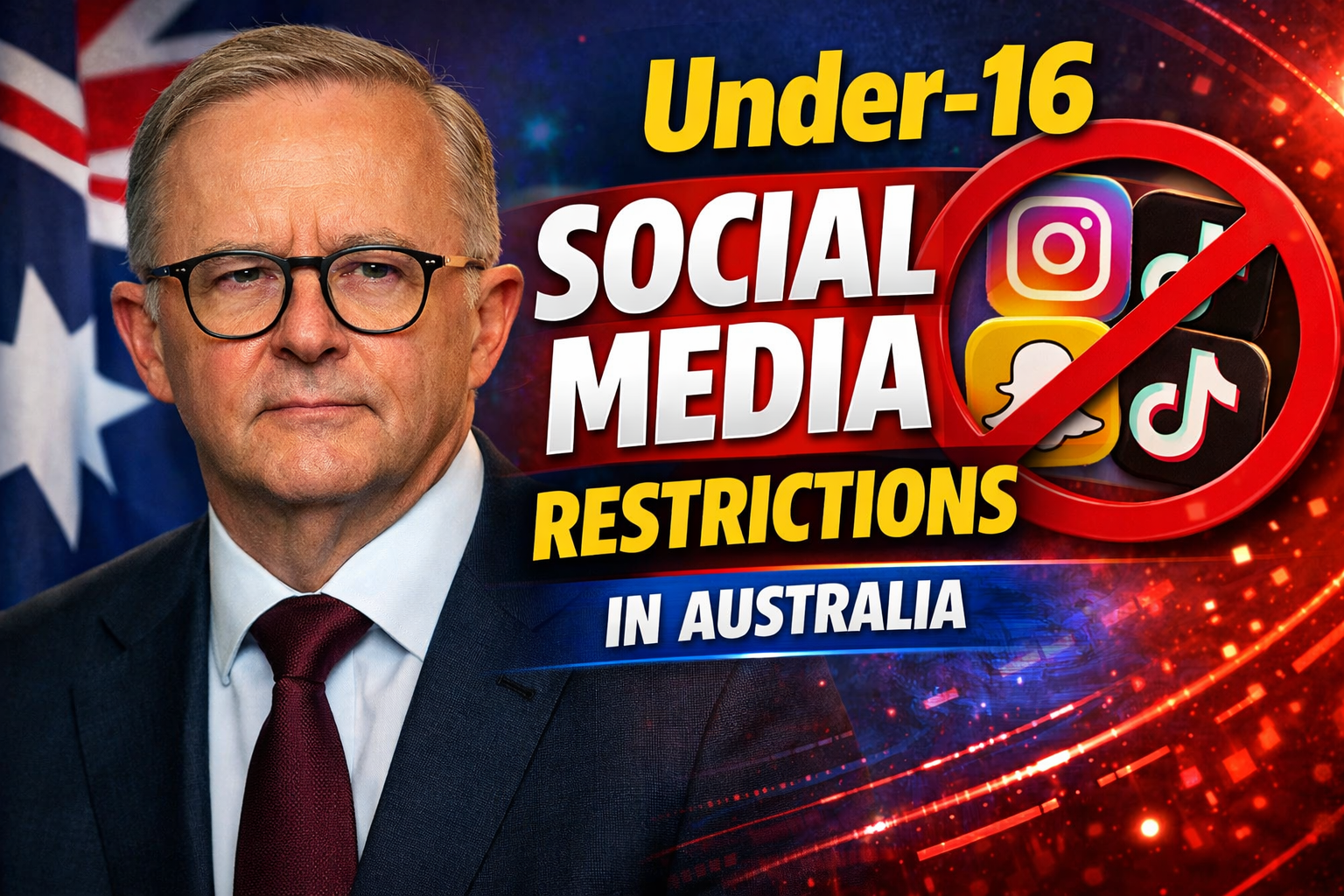
Australia enforces a world-first ban on social media for under-16s starting December 10, 2025, requiring platforms to deactivate existing accounts and block new ones using robust age verification. The eSafety Commissioner oversees compliance, mandating reasonable steps like facial age estimation and data inference to protect children from addictive designs, cyberbullying, and harmful content. Platforms face fines up to 49.5 million AUD for failures, with millions of teen accounts already affected as enforcement ramps up into 2026.
Legislative Origins
Parliament passed the Online Safety Amendment (Social Media Minimum Age) Act in late 2024, responding to evidence of social media’s toll on youth mental health. Over half of young Australians face cyberbullying, while addictive algorithms drive excessive screen time and exposure to unsafe content. The law shifts responsibility to platforms, previously reliant on self-reported ages that minors easily bypassed.
Effective December 10, 2025, it targets age-restricted services—platforms primarily for social interaction like sharing posts or videos. A trial phase in early 2025 tested technologies, paving full enforcement. eSafety Commissioner Julie Inman Grant leads implementation, issuing regulatory guidance emphasizing proactive detection over parental controls.
Covered Platforms and Scope
Ten platforms bear immediate obligations: Facebook, Instagram, TikTok, Snapchat, X (formerly Twitter), YouTube, Reddit, Kick, Twitch, and Threads. These services must prevent Australian under-16s from holding accounts, covering both existing profiles and new sign-ups. Bluesky voluntarily joined despite low-risk status due to its small user base.
The ban excludes messaging apps, gaming platforms, or educational sites without social features. Providers self-assess risk, but eSafety designates high-impact ones. Millions of accounts deactivated on day one, with users prompted to download data before lockout.
| Platform | Key Features Affected | User Impact |
|---|---|---|
| TikTok | Video sharing, trends | Account deletion/archiving |
| Instagram/Facebook | Photos, stories, reels | Data download, hold until 16 |
| Snapchat | Ephemeral messaging | Locked profiles |
| YouTube | Video comments, community | Age-gated access |
| X/Reddit/Twitch | Posts, live streams | Deactivation required |
Scope ensures broad protection without overreach.
Age Verification Technologies
eSafety mandates “reasonable steps” combining multiple methods for high confidence. Platforms start with existing data: behavioral signals, location patterns, and upload histories inferring age. Facial age estimation scans selfies against AI models, flagging 15-21 buffer zones for deeper checks.
Options include credit card verification (minors unlikely to hold), government ID matching, or third-party services. Inference uses proxies like bank accounts or licenses. No single method suffices; layered approaches minimize errors. Guidance stresses privacy-preserving tech, avoiding biometrics storage where possible.
| Method | How It Works | Pros/Cons |
|---|---|---|
| Facial Estimation | AI analyzes photo age range | Non-invasive / Accuracy varies |
| Data Inference | Usage patterns, location | Uses existing info / Potential bias |
| ID/Credit Check | Document or payment scan | High certainty / Privacy concerns |
| Behavioral Signals | Account history analysis | Passive / Less precise alone |
Hybrid systems balance effectiveness and usability.
Platform Compliance Roadmap
Providers detect under-16 accounts via algorithms scanning profiles created before enforcement. Notifications inform users of deactivation, offering data exports. New sign-ups trigger upfront verification, blocking fake birthdays or VPN workarounds.
Grievance mechanisms allow appeals: wrongly banned teens prove age via ID, while over-16s flagged young contest via support. Platforms report progress quarterly to eSafety, with audits possible. Initial focus: mass deactivations, followed by real-time prevention.
Steps ensure circumvention-proofing, like IP tracking Australian users.
User Experience and Appeals
Teens receive clear notices explaining lockouts until age 16, with options to archive content. Parents cannot override; focus stays on platforms. Appeals process: submit ID or alternative proof within set windows, with eSafety oversight for disputes.
VPNs or fake details trigger flags, but enforcement prioritizes cooperation over punishment. Schools and families prepare via eSafety hubs offering guides.
Enforcement and Penalties
Non-compliant platforms risk civil penalties up to 49.5 million AUD, scaled by revenue. eSafety monitors via complaints, audits, and data requests. Christmas 2025 updates assess early effectiveness, with refinements into 2026.
Industry codes—registered June and September 2025—bolster rules for explicit content age gates, effective December 2025 and March 2026. Violations carry 9.9 million AUD fines.
| Violation Type | Penalty Cap | Oversight |
|---|---|---|
| Account Failures | 49.5M AUD | eSafety audits |
| Code Breaches | 9.9M AUD | Mandatory compliance |
| Circumvention | Scaled fines | Quarterly reports |
Deterrence drives proactive measures.
Privacy and Data Protections
Guidance aligns with Australian Privacy Principles: minimize collection, delete post-verification data, and enable consent withdrawals. Biometrics avoided unless hashed securely. EU-style digital wallets eyed for future interoperability.
Global partners like UK’s Ofcom and EU Commission collaborate on standards. Platforms anonymize signals where feasible.
Reactions and Challenges
Parents applaud reclaiming control from tech giants, but critics question enforceability and free speech. Teens swap numbers for verification hacks, while platforms warn of false positives. International scrutiny grows, with potential model for others.
2026 hurdles: scaling tech amid growth, rural access gaps, and indigenous considerations.
Future Outlook
By mid-2026, expect refined systems and impact reports. Success metrics: reduced youth harms, maintained platform viability. eSafety evolves rules based on data, potentially expanding buffers or methods.
This pioneering framework positions Australia as online safety leader, balancing protection with innovation.

Nirti Singh is a news writer and digital content contributor at KorakoSpecklePark, covering key stories and regional developments across New Zealand and Australia. Her work focuses on clear, fact-based reporting, ensuring readers receive accurate and timely information.