
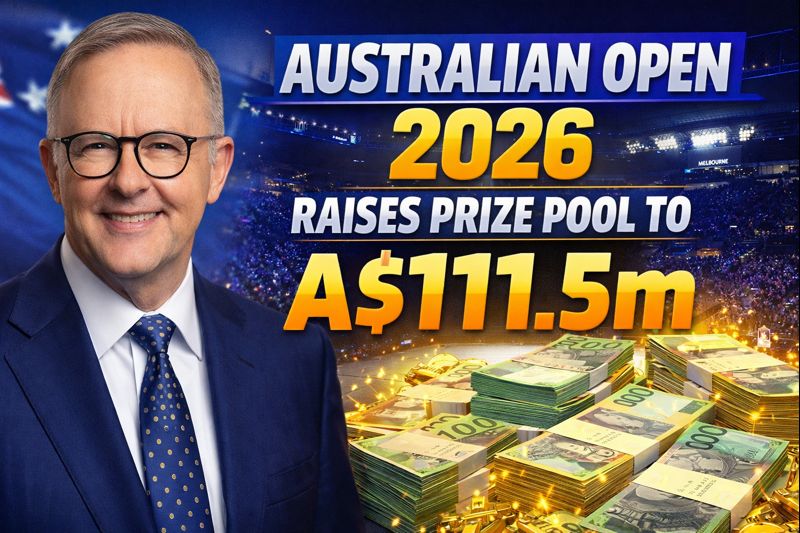
The Australian Open has shattered records by boosting its total prize pool to A$111.5 million for the 2026 edition, a 16 percent jump from last year’s A$96.5 million, marking the first time it crosses the nine-figure mark in AUD. This massive increase, announced by Tennis Australia CEO Craig Tiley on January 5, elevates payouts across every round, with singles champions now pocketing A$4.15 million—a 19 percent hike—and first-round losers guaranteed A$150,000. The surge underscores Melbourne Park’s ambition to lead grand slams in player earnings while fueling the broader Australian summer of tennis with A$135 million invested across events.
Qualifying rounds see 16 percent rises too, reflecting support for emerging talent amid rising tour costs. However, the windfall sparks mixed reactions: While top stars celebrate, lower-ranked players and voices like Coco Gauff question if early-round boosts truly offset inflation and travel burdens. As qualifying kicks off January 12 and the main draw January 18 through February 1, this payout revolution intensifies debates on equity in a sport where expenses devour earnings for many.
Prize Money Breakdown
Tennis Australia’s structure ensures parity between men’s and women’s singles, with doubles teams sharing scaled rewards. Champions claim the lion’s share, but increments cascade down, making even modest runs lucrative.
Singles Prize Money (Men & Women, per player)
| Round | Amount (A$) | Increase from 2025 |
|---|---|---|
| Winner | 4,150,000 | +19% |
| Runner-up | 2,150,000 | +13% |
| Semifinalist | 1,250,000 | +14% |
| Quarterfinalist | 750,000 | +13% |
| Round of 16 | 480,000 | +14% |
| Round of 32 | 327,750 | +13% |
| Round of 64 | 225,000 | +13% |
| First Round | 150,000 | +14% |
Qualifying Singles (per round)
| Round | Amount (A$) |
|---|---|
| Q1 | 40,500 |
| Q2 | 57,000 |
| Q3 | 83,500 |
Doubles per team follows suit: Winners get A$900,000, up proportionally, while early exits earn A$44,000 in the first round. This historic pool outpaces Wimbledon’s 2025 equivalent and edges closer to US Open levels, funded by broadcasting deals, sponsorships, and ticket surges.
Tennis Australia’s Rationale
Craig Tiley hailed the hike as proof of “commitment to supporting tennis careers at every level,” noting qualifying pay has risen 55 percent since 2023. The investment spans United Cup, Brisbane, Adelaide, and Hobart, cultivating deeper talent pipelines. Executives tie it to commercial growth: Record attendance, ESPN deals, and Rolex partnerships swell coffers, enabling sustainable payouts.
Tiley emphasized player benefits beyond cash—enhanced facilities, mental health support, and charter flights—addressing burnout. For wildcards, first-round guarantees offset risks, while qualifiers gain financial cushions for grueling seasons. This positions Melbourne as the “most generous” slam, countering French Open critiques on unequal doubles cuts.
Player Complaints Surface
Not everyone cheers. Lower-ranked pros argue inflation erodes gains—travel, coaching, and physio costs ballooned 20-30 percent post-pandemic—leaving qualifiers barely breaking even after taxes and agents. A first-round loss yields A$150,000 pre-tax, but European or American players forfeit thousands on flights alone. Doubles specialists gripe at stagnant relative shares, echoing 2024 French Open boycotts.
Wildcard entrants, often juniors or returnees, welcome guarantees but decry inequality: Top-100 safety nets pad banks, while sub-200 players scrap. PTPA chair Novak Djokovic praised early-round boosts but called for tour-wide redistribution, hinting ATP-WTA merger talks. Critics like Nick Kyrgios blast “trickle-up” economics, urging 25 percent of revenue to lower tiers.
Travel burdens amplify gripes: Asia-Pacific qualifiers fly economy, while stars jet privately. Injury-prone schedules exacerbate woes, with players like Reilly Opelka noting U.S. taxes devour half earnings.
Coco Gauff’s Key Reactions
Coco Gauff, the 2025 runner-up and teen sensation, offered measured praise laced with caveats during January 10 media in Melbourne. “It’s great to see the numbers go up—shows the sport’s growing—but we need to think about the bottom,” she said, spotlighting qualifiers facing A$40,000 Q1 pay after weeks away from home. Gauff, earning millions off-court via New Balance and Rolex, advocated holistic support: Free physio for all draws, subsidized housing, and pension funds.
Her comments echo 2025 US Open equity pushes, where she joined Djokovic in PTPA calls for 50-50 doubles splits. Gauff highlighted American disparities: U.S. players lose 37 percent to taxes, versus 20 percent for Aussies. “Records are cool, but sustainability matters more,” she urged, tying it to diversity—more funding retains global talent.
Fans lauded her maturity; social media dubbed her “voice of reason,” amplifying debates as she eyes a first AO title.
Top Players Weigh In
Jannik Sinner, world No. 1, called it “fantastic motivation,” eyeing A$4.15 million after 2025 semis. Carlos Alcaraz joked he’d “retire happy” with such sums, praising parity. Aryna Sabalenka welcomed women’s boosts, crediting trailblazers like Osaka.
Novak Djokovic, 24-time slam king, balanced applause with reform calls: “Lift the floor higher—many live paycheck-to-paycheck.” Iga Swiatek focused on qualifiers, while aging stars like Andy Murray retired buoyed by late-career rises. Rivals like Alexander Zverev pushed PTPA transparency on revenue splits.
Notable Player Quotes
- Sinner: “Pushes everyone to dream big.”
- Djokovic: “Great step, but tour needs unity.”
- Sabalenka: “Fair for women—keep it coming.”
- Gauff: “Help the qualifiers too.”
Historical Context and Comparisons
The 2026 pool eclipses 2021’s A$71 million (Djokovic-Osaka era), doubling in five years amid streaming booms. US Open leads at A$115 million equivalent, but AO’s 16 percent leap tops Wimbledon’s 10 percent. French Open lags, prioritizing clay purity over cash.
Since 2000, winner pay quadrupled, but inflation-adjusted, early rounds barely budged until recent surges. AO’s trajectory mirrors NFL/NBA growth, betting on stars like Sinner and Gauff for TV dollars.
Grand Slam Prize Pools (2026 Est.)
| Tournament | Total (A$ equiv.) | Winner (A$) |
|---|---|---|
| Australian Open | 111.5m | 4.15m |
| US Open | ~115m | ~4.2m |
| Wimbledon | ~105m | ~3.8m |
| French Open | ~95m | ~3.5m |
Economic Impact on the Sport
Melbourne reaps billions: 1 million visitors pump A$300 million into Victoria’s economy via hotels, dining, and retail. Broadcasters gain—ESPN pays premium for Gauff storylines—while sponsors like Kia fund hikes. Globally, it lures talent: South Americans cite AO cash as tour lifeline.
Equity advances shine: Women’s parity since 2001, plus wildcard protections, foster depth. Yet agents warn burnout risks if schedules inflate.
Broader Tournament Details
Qualifying runs January 12-15 at Melbourne Park, main draw January 18. Rod Laver Arena hosts finals February 1, with night sessions featuring LED lights and fan zones. Seeds drop January 14; wildcards favor Aussies like Alex de Minaur.
Player perks expand: 500 hotel rooms subsidized, wellness pods, and nutrition hubs. Amid heat policies, shaded courts and ice vests mitigate 40°C risks.
Future Outlook and Reforms
Tiley eyes A$120 million by 2027, tying to AO Live expansions. PTPA pushes mandatory floors—US$1 million minimum for top-200—while WTA eyes equal doubles. Gauff’s advocacy signals generational shifts toward sustainability.

Nirti Singh is a news writer and digital content contributor at KorakoSpecklePark, covering key stories and regional developments across New Zealand and Australia. Her work focuses on clear, fact-based reporting, ensuring readers receive accurate and timely information.