
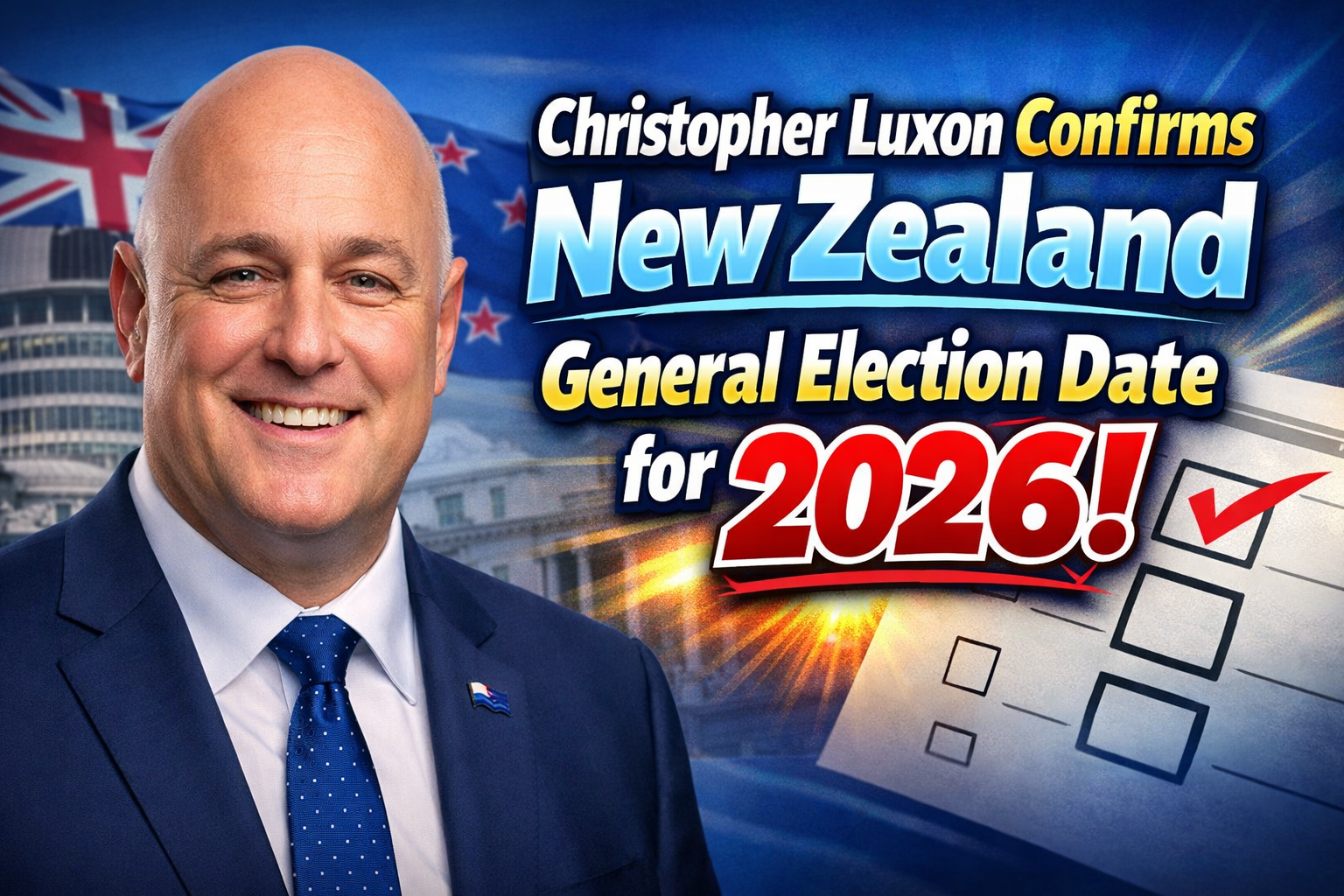
Prime Minister Christopher Luxon has officially set the date for New Zealand’s next general election on Saturday, November 7, 2026. This announcement delivers early certainty to voters and political parties alike, upholding a longstanding tradition in Kiwi politics.
Announcement Details
Luxon revealed the date during the National Party’s caucus retreat in Christchurch earlier this week. Speaking to gathered media, he emphasized the importance of providing clarity at the start of the political year. The prime minister holds sole authority over the election timing, within the three-year parliamentary term, and chose a mid-November slot to align with historical patterns.
Parliament will dissolve on October 1, with writs issued four days later. Nominations close at midday on October 8, advance voting begins October 26, and the final writ return deadline falls on December 3. This timeline allows ample preparation for campaigns across the nation, from bustling Auckland to remote South Island towns.
Background on Election Timing
New Zealand’s mixed-member proportional (MMP) system has shaped elections since 1996, with most occurring between September and November. Luxon’s decision continues this trend, avoiding the holiday rush near the last possible date of December 19. Past leaders, including Jacinda Ardern and John Key, followed similar early announcements to focus on governance post-reveal.
The choice of November 7 comes after the U.S. midterms on November 3, offering insights into global shifts under President Donald Trump’s administration. Political analysts note this timing lets Luxon monitor international economic cues affecting trade, inflation, and migration—key voter concerns. Domestically, it caps a year of policy delivery, from housing reforms to economic recovery measures.
Luxon’s Political Strategy
The announcement doubles as a campaign launchpad for National. Luxon positioned his party as the steady hand, highlighting achievements like stabilizing inflation and boosting business confidence. He reaffirmed openness to coalitions with ACT and New Zealand First, while firmly ruling out Labour partnerships, sending a clear message to undecided voters.
National’s narrative centers on “getting the country sorted,” with pledges for KiwiSaver enhancements and infrastructure acceleration. Luxon stressed proven governance, pointing to coalition stability since 2023. This move pressures opponents, forcing early manifesto drafts amid rising living costs and housing debates.
Reactions from Opposition Parties
Labour leader Chris Hipkins welcomed the certainty but criticized the timing as self-serving. He argued it shortens the campaign window, potentially favoring incumbents with established networks. Green Party co-leader Chlöe Swarbrick called for bolder climate action in the lead-up, viewing the date as a cue to amplify environmental urgency.
ACT’s David Seymour praised the early call, seeing it as business-like efficiency. New Zealand First’s Winston Peters hinted at flexibility in post-election talks, teasing policy surprises. Smaller parties like Te Pāti Māori expressed readiness, focusing on indigenous rights and rural inequities. Overall, reactions underscore MMP’s coalition dynamics, where no single party dominates.
Voter Turnout and Historical Stats
New Zealand boasts high voter engagement, with the 2023 election hitting 82.2 percent turnout—the highest since 1996. Advance voting surged to 38.2 percent of total ballots, up from previous years, thanks to accessible polling stations. For 2026, officials anticipate similar or higher figures, driven by digital enrollment and youth mobilization efforts.
| Election Year | Total Enrolled Voters | Turnout Percentage | Advance Votes Percentage |
|---|---|---|---|
| 2023 | 3,777,362 | 82.2 | 38.2 |
| 2020 | 3,374,608 | 82.2 | 31.7 |
| 2017 | 3,231,968 | 79.0 | 19.0 |
| 2014 | 3,139,756 | 77.0 | 34.1 |
| 2011 | 3,010,886 | 74.2 | 16.8 |
These figures reflect growing participation, especially among under-30s, fueled by issues like affordability and climate. Electoral Commission data shows urban areas like Wellington and Christchurch consistently lead turnout, while rural seats lag slightly due to geographic challenges.
Key Issues Shaping the Campaign
Housing remains paramount, with National touting consents up 25 percent since 2023. Critics counter that supply lags demand, pushing median prices near one million dollars. Economic recovery dominates, as GDP growth stabilizes at 1.8 percent annually, per Treasury forecasts, amid global uncertainties.
Climate policy divides: National prioritizes adaptation funding, while Greens demand emissions cuts. Immigration debates intensify, with net migration at 173,000 last year, straining infrastructure. Healthcare waitlists, at record highs, prompt promises of nurse recruitment drives. Education gaps, particularly in literacy, feature in all platforms.
Economic Context Influencing Voters
New Zealand’s economy shows resilience post-pandemic. Unemployment hovers at 4.7 percent, inflation cools to 2.1 percent within the Reserve Bank’s target. Exports to India and China rebound, bolstered by recent free trade talks. However, household debt at 165 percent of disposable income fuels cost-of-living angst.
| Economic Indicator | 2023 Value | 2025 Projection | Change |
|---|---|---|---|
| GDP Growth | 0.7% | 1.8% | +1.1% |
| Inflation | 4.0% | 2.1% | -1.9% |
| Unemployment | 3.9% | 4.7% | +0.8% |
| Net Migration | 173,000 | 120,000 | -53K |
Treasury reports underscore fiscal discipline, with surpluses eyed by mid-2026. Luxon’s team leverages these metrics to claim mandate renewal, contrasting with opposition narratives of uneven recovery.
Role of Coalitions in MMP Era
Since MMP’s inception, no party has won outright majority. National’s 2023 coalition secured 48.3 percent vote share, translating to 38 percent seats via overhangs. ACT and NZ First added crucial margins. Polls project National leading at 36 percent, Labour at 29, Greens 12, and Te Pāti Māori rising to 4 percent.
Coalition math remains fluid. Luxon’s exclusions streamline talks but risk alienating swing voters. Historical pacts show ACT’s influence on deregulation, NZ First on superannuation. This election tests MMP maturity, with thresholds at 5 percent or electorate wins.
Media and Public Response
Coverage exploded post-announcement, dominating RNZ, NZ Herald, and Stuff.co.nz. Social media buzzed, with #NZElection2026 trending nationwide. Pundits praise Luxon’s decisiveness, echoing John Key’s 2011 playbook. Public sentiment, per initial Taxpayers’ Union polls, favors stability at 51 percent.
Regional disparities emerge: Auckland prioritizes transport, Canterbury agriculture. Māori media like Whakaata Māori spotlights treaty claims. Digital campaigns gear up, with parties investing in TikTok for Gen Z outreach.
Implications for Global Relations
The election coincides with U.S. post-midterms flux and EU trade negotiations. Luxon eyes strengthened Pacific ties, including AUKUS pillars. An India-NZ free trade deal nears fruition, promising dairy export boosts. Domestically, China relations stabilize amid espionage probes.
Voters weigh isolationism versus alliances. National pledges defense spending hikes to 2 percent GDP, aligning with Five Eyes partners.
Path to November 7
Nine months stretch ahead, packed with debates, town halls, and policy drops. Early voting innovations, like mobile booths, aim to lift turnout. Electoral boundaries finalize soon, potentially redrawing marginal seats.
Luxon’s gambit bets on incumbency edge. Opposition unites around change themes. As writs drop, New Zealand braces for passionate discourse, cementing its democratic vibrancy.

Nirti Singh is a news writer and digital content contributor at KorakoSpecklePark, covering key stories and regional developments across New Zealand and Australia. Her work focuses on clear, fact-based reporting, ensuring readers receive accurate and timely information.